06 August 2026
Wine Box Size Guide by Bottle Type
Wine box size is driven by bottle shoulder diameter, height and insert wall thickness, not by the bottle's nominal volume. Get those three numbers right and the box fits. Here is how we size each bottle family, what changes for multi-bottle layouts, and which measurements to send for a quote.
Start with the bottle, not the label
A 750 ml Bordeaux and a 750 ml Burgundy do not go in the same box. The Bordeaux has a straight shoulder and a fairly uniform diameter. The Burgundy slopes from a wide base to a narrower neck. That changes the insert cavity shape, the box depth, and how the bottle sits. Volume tells you almost nothing. The label does not help either. We need the glass.
Three measurements matter most: maximum shoulder diameter, total height, and the diameter at the widest point of the base. Shoulder diameter sets the insert cavity. Height sets the internal depth. Base diameter matters when bottles lie down or share a tray. If you only send volume, we will ask for these anyway. Save a round of email and measure the bottle.
Four bottle families we see every week
Bordeaux bottles are the easiest. Straight sides, tall shoulder, predictable. The insert cavity can be close to the glass because the bottle slides in vertically. Burgundy bottles slope, so a cavity that fits the base will be loose at the neck. That is fine if the insert holds the bottle at four points, but it means the cavity profile has to be drawn carefully. A straight cylinder insert will not work.
Rhone and heavy-punt bottles often carry more weight low down. The punt changes the base profile, and the shoulder can be broader than a Bordeaux. We check the base diameter against the insert wall. If the insert is too thin, the bottle rocks. If it is too thick, the box grows for no reason. Sparkling and champagne bottles have a wider base, thicker glass, and a pronounced shoulder. They need more clearance. The insert cavity is usually 2 to 4 mm larger in diameter than a still wine bottle of the same height. Again, volume does not tell you that.
- Bordeaux: straight shoulder, close cavity fit.
- Burgundy: sloping shoulder, custom cavity profile.
- Rhone: heavy base, check punt and shoulder width.
- Champagne: wider base, thicker glass, more clearance.
Insert type changes internal size
The insert wall thickness is not zero. A velvet tray adds maybe 3 to 5 mm per side. EVA foam can be cut thinner but compresses under load. Blister inserts hold shape well but need a rigid base. Paper mould, sometimes called moulded pulp, is the thinnest option but has less give. Each material changes the internal box size for the same bottle.
Our control tolerance is insert plus or minus 1 mm, box body plus or minus 2 mm. That sounds tight, but it means two boxes off the same line can differ by up to 4 mm in internal width. If you design the cavity with zero clearance, some boxes will not close. We always leave clearance. The insert rule is simple: bottle held at four points, no unsupported neck or shoulder. Then we shake the loaded box for 10 seconds, tilt it 45 degrees, and invert it. If the bottle moves, the insert is wrong.
Multi-bottle layouts: upright or lying down
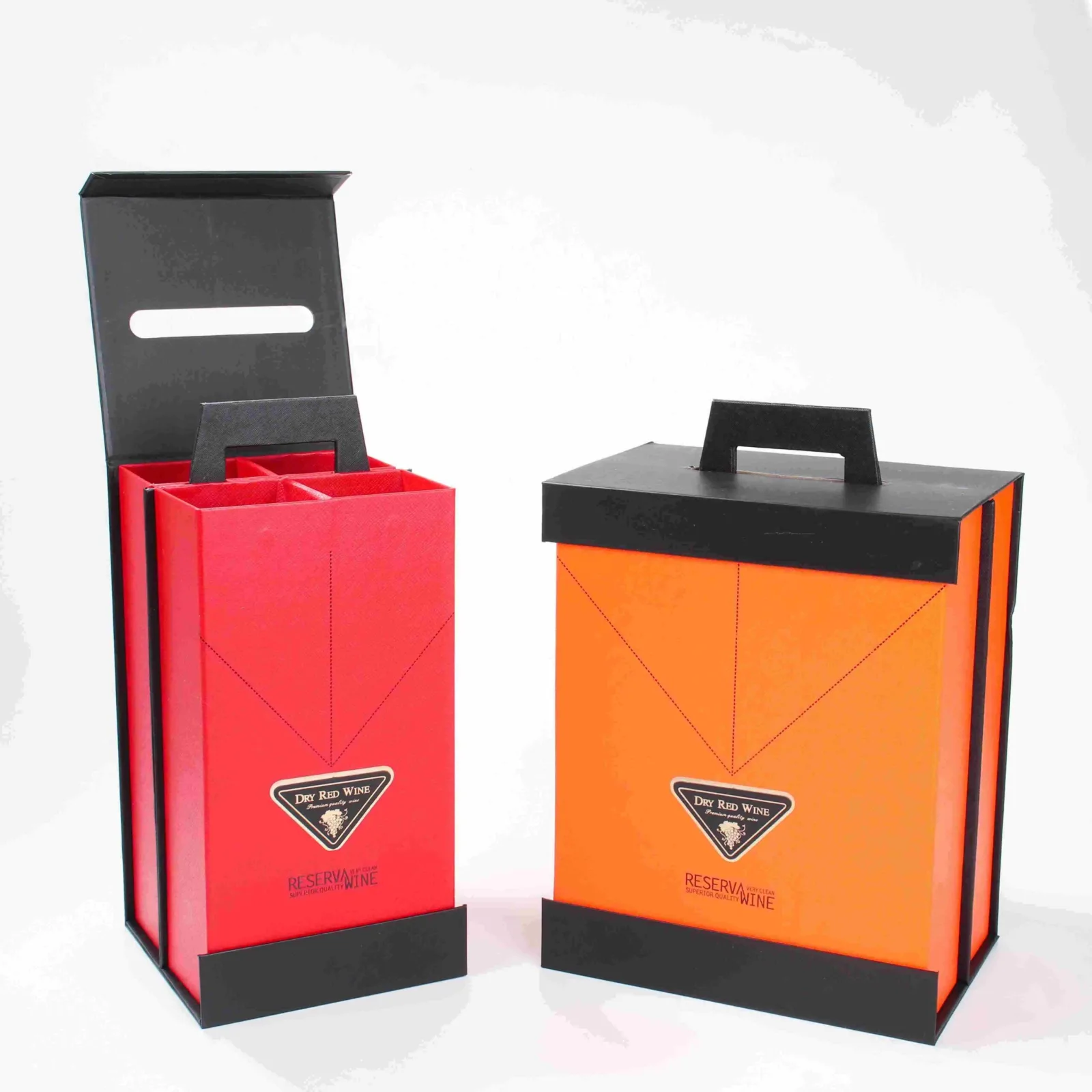
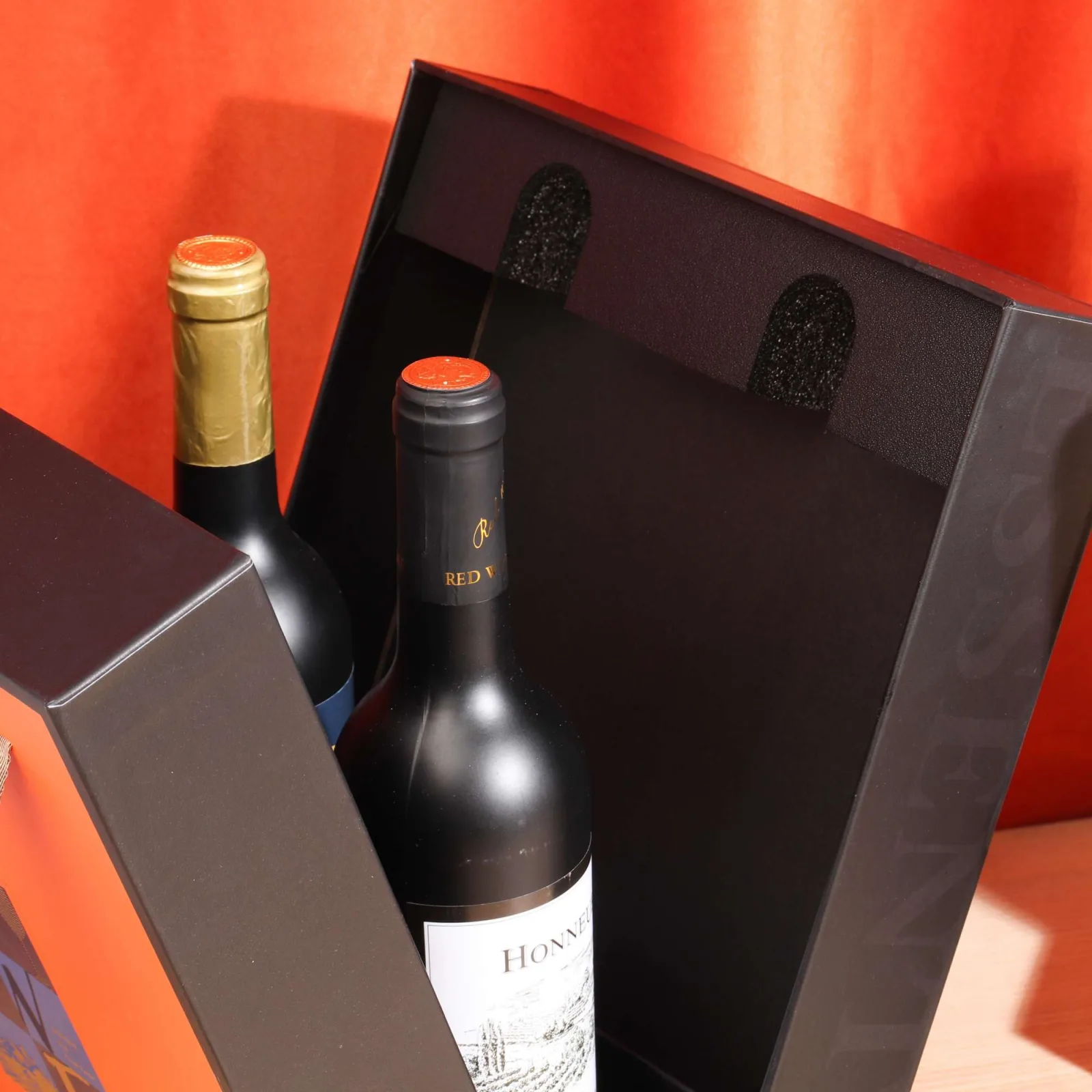
Side by side is the most common two-bottle layout. The boxes often use a divider or two separate cavities. Lying down, the bottle rests on its side, so the box depth becomes the bottle diameter plus insert thickness. Upright, the depth is the bottle height plus clearance. Double door boxes open like a book with a bottle on each side. That changes the hinge and closure clearance, not just the cavity.
Four and six bottle trays are usually upright. The tray is divided, and each cavity is sized to the bottle family. A six-bottle Bordeaux tray is not a six-bottle Burgundy tray. The Burgundy tray will be wider because the base is wider. If you want one tray to fit both, it has to be sized for the larger bottle and the Bordeaux will rattle. That is a trade-off we flag before cutting tooling. For Two-Bottle Double-Door Presentation Box we work through the closure clearance carefully because the box has to close flat with two bottles inside.
Board and paper set the outside size
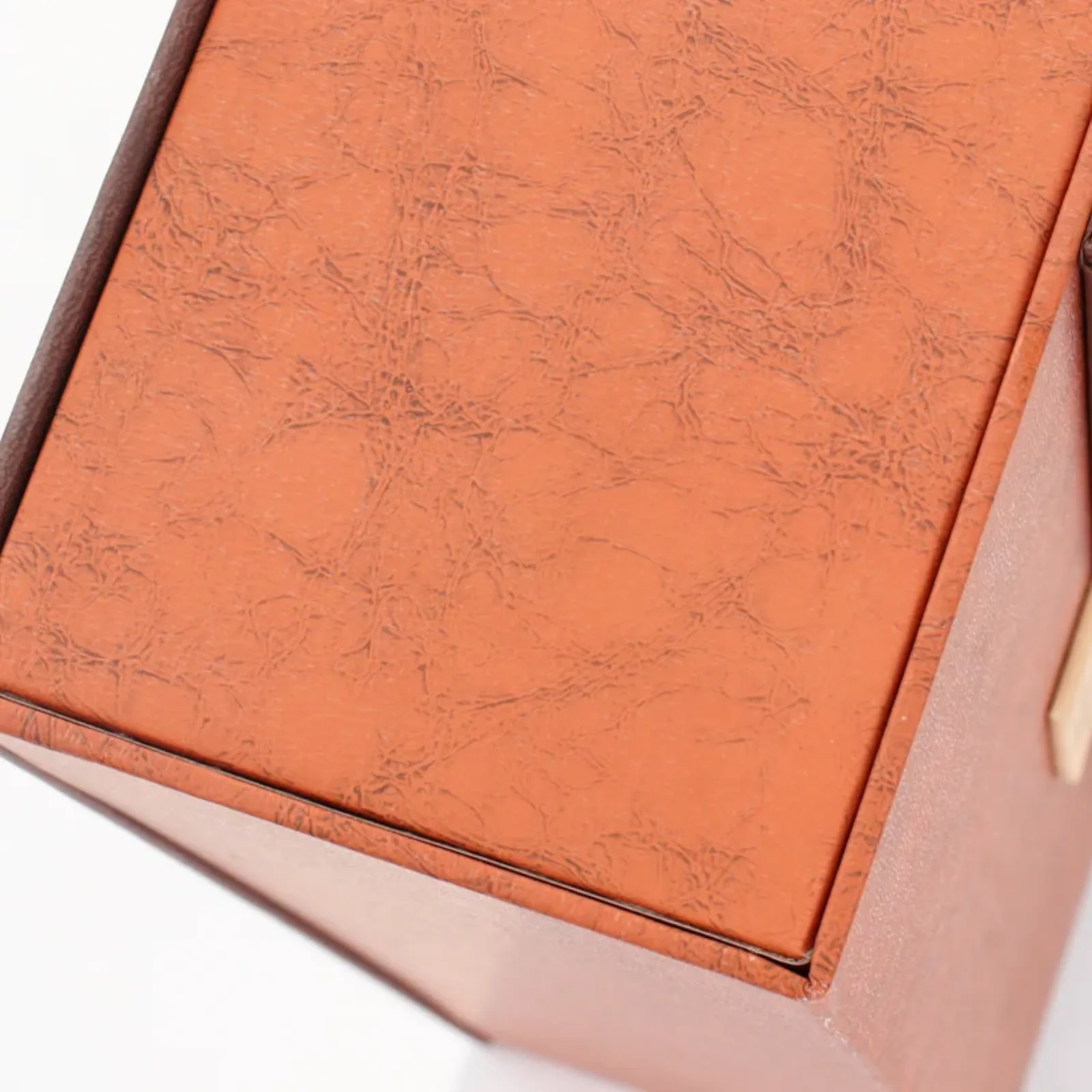
The internal size is the bottle plus insert. The external size adds board thickness and facing paper. Our standard is greyboard 1200 g minimum, 1400 g recommended for spirits. Facing paper is 157 g minimum specialty or coated. That adds roughly 4 to 6 mm to each external dimension, depending on structure. A rigid lid-and-base box with a velvet tray will be larger outside than a foldable box for the same bottle.
Foldable boxes have their own issues. Creases must not crack, magnet position is plus or minus 1 mm, and corners must sit at 90 degrees when erected. If the board is too thin, the box bulges at the sides and the lid will not sit. We see that failure on cheap shipping boxes. For Cardboard Wine Boxes the structure is often a rigid box with a hinged lid, so the external depth includes the lid board. For Wine Gift Boxes the insert is usually velvet or EVA, and the box is deeper than a shipping box.
Checklist before you ask for a quote
Measure the bottle, not the label. Maximum shoulder diameter, total height, widest base diameter. Then decide the orientation: upright or lying down. Then the insert type. Then the bottle count and layout. That is enough for a first size check.
If you have a reference design, send it. A photo of a box you like, a drawing, a competitor's listing. We can reverse-engineer the structure from the photo and tell you what board and insert it uses. For Materials and structures we list the common combinations. For Custom Wine Box Manufacturing we explain the eight production steps from consultation to packing.
- Maximum shoulder diameter in millimetres.
- Total bottle height in millimetres.
- Widest base diameter in millimetres.
- Bottle count and layout: side by side, tray, double door.
- Insert preference: velvet, EVA, blister, paper mould.
What we check before shipping
Every box we ship goes through our in-house checks. Loaded with a bottle, we drop it from 1.2 m on six faces. We stack top load 40 kg or more for 24 hours. We run truck and sea vibration simulation and check for internal movement. If the bottle shifts, the insert is redrawn. If the lid does not close after the drop test, the board or hinge is wrong.
Black, deep blue and burgundy facing papers are the hardest to hold in colour. We match Pantone, approve a first article, and sample mid-run. That does not change the size, but it changes how the box looks after lamination. A box that is the right size but the wrong colour is still a reject.
Key points
- Measure shoulder diameter, height and base diameter, not volume.
- Burgundy and champagne need wider cavities than Bordeaux.
- Insert wall thickness adds 3 to 5 mm per side.
- Control tolerance is plus or minus 1 mm insert, 2 mm box body.
- Send bottle sample or dimensions, quantity, reference design.
Questions buyers ask
Can you size a box from just the bottle volume, like 750 ml?
No. A 750 ml Bordeaux and a 750 ml Burgundy have different shoulder and base profiles. We need maximum shoulder diameter, total height and widest base diameter. Volume alone leads to boxes that are too tight or too loose.
How much clearance should I leave between the bottle and the insert?
Leave enough for the insert tolerance of plus or minus 1 mm and the bottle's own variation. For most bottles, 2 to 4 mm total clearance around the shoulder works. Champagne and sparkling need a bit more because the base is wider and glass is thicker.
What is the difference between a velvet tray and an EVA foam insert for sizing?
Velvet trays are thicker, usually 3 to 5 mm per side, and add more to the external box. EVA foam can be cut thinner but compresses. Paper mould is the thinnest. The internal cavity is the same, but the outside box size changes with the insert.
Send us your bottle dimensions or a sample, the quantity, and any reference design, and we will size the box and insert before you commit to tooling. Get a Quote
Put this on your bottle
Send the bottle sample or dimensions, quantity and a reference design. We reply with structure options and pricing.
- Email[email protected]