Materials and Structures
You don't have to be a packaging engineer to spec a good wine box. You do need to know how the materials behave. This page covers the board, the facing papers, the structures and the inserts we use, including where each one is the wrong pick.
The board standard
We build on greyboard at 1200 g minimum. For spirits and heavier bottles, 1400 g is the safer call. The weight matters because it's what keeps a rigid box rigid after it's been opened, closed and handled. We don't use recycled greyboard or high-moisture paper. Those cause warping and weak corners. You'll feel the difference when you pick the box up: 1200 g holds its shape, 1400 g feels substantial. If your bottle is on the heavy side, go 1400 g.
Six common materials
Greyboard with specialty paper
The standard for rigid boxes. It takes foil and embossing cleanly, and the specialty paper wrap hides the board edge. Wears well on a retail shelf.
Kraft paper
Good for shipping boxes and eco-positioned gift boxes. It prints in one or two colours without much trouble, but heavy ink coverage can look flat.
White card
Used for folding cartons and inner sleeves. It takes four-colour printing well, but it's not rigid enough for a lid-and-base box on its own.
Gold or silver cardboard
A metallic facing that adds shelf pop. It can show fingerprints, so it's better for gift boxes than for boxes that get handled a lot.
Flocked paper
The soft, suede-like facing you see on premium single-bottle boxes. It hides scratches, but it doesn't take fine print or foil as sharply as specialty paper.
Leather-textured paper
A paper facing embossed to feel like leather. It's less expensive than real leather and easier to print, but it won't patina the way leather does.
Six box structures
Rigid lid-and-base
The classic two-piece box. Strong, stackable, and easy to open. It's the default for premium single-bottle and two-bottle sets.
Magnetic closure
A rigid box with magnets in the flap. It closes with a satisfying snap and stays shut. Good for gift boxes that get opened and closed repeatedly.
Drawer
A sleeve with a sliding tray. It feels more like a presentation case than a box. Works well for sets with glasses or accessories.
Foldable
A rigid box that ships flat and erects with folded corners. It saves freight, but the creases must not crack and the corners need to hold 90 degrees.
Double-door
Two front panels that open like doors. It's a dramatic reveal for a single bottle. More moving parts means more hand assembly.
With handles
A rigid or foldable box with a rope, ribbon or die-cut handle. Useful for two-bottle gift boxes that people carry home from the store.
Four insert types
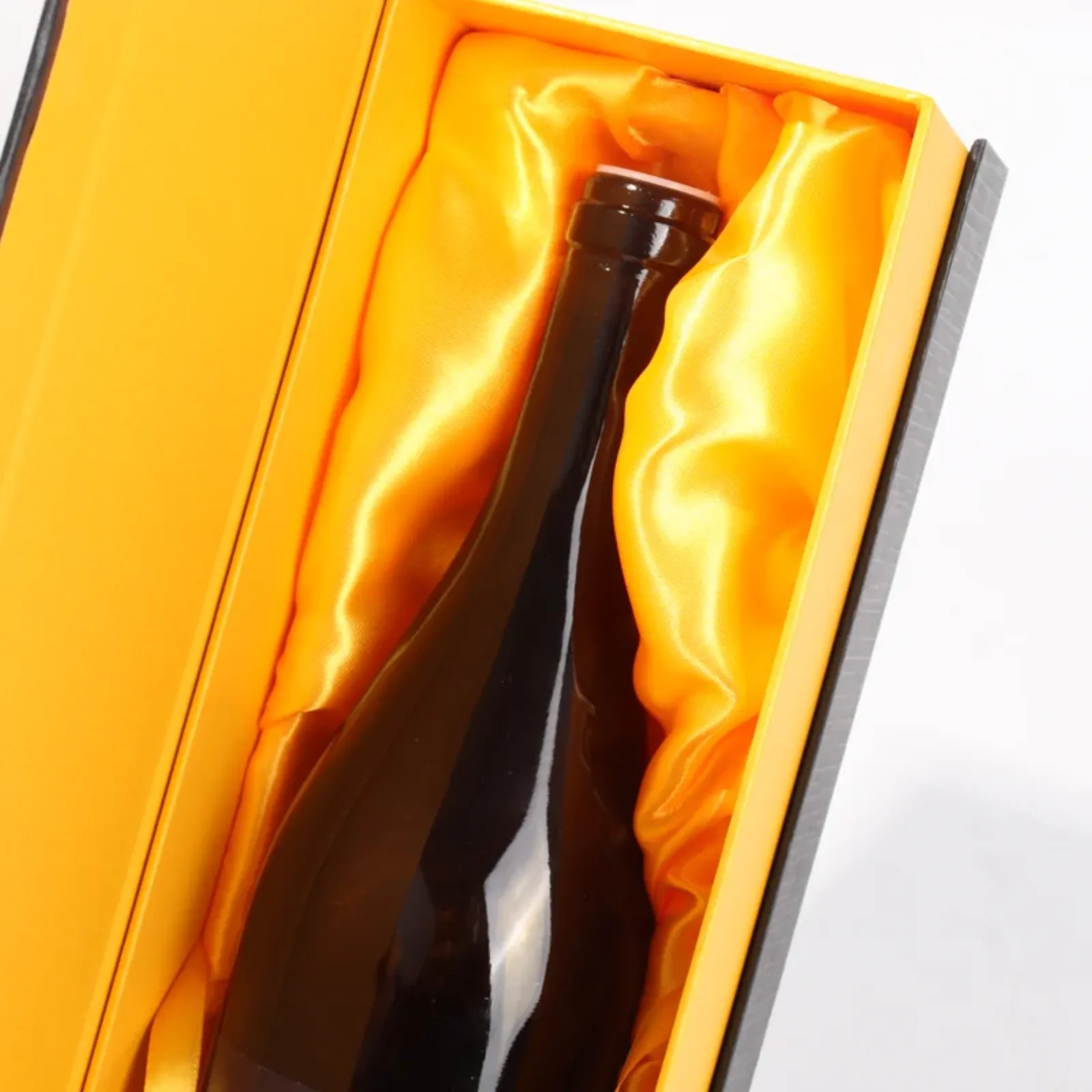
Velvet tray
A thermoformed tray covered in velvet. It holds the bottle snugly and looks premium. Best for single-bottle gift boxes.
EVA foam
A dense foam insert, usually die-cut to the bottle profile. It's the most protective option and works for shipping boxes as well as gift boxes.
Blister
A clear plastic shell that shows the bottle while holding it in place. Good for retail display, but it can look cheap if the box is otherwise plain.
Paper mould
Moulded pulp, sometimes called paper mould. It's recyclable and inexpensive, but it's not as precise as EVA or velvet. Best for shipping boxes.
Picking a combination
Start with the bottle. Its weight, height and shoulder shape determine the insert. A heavy bottle needs EVA or a well-fitted velvet tray. A light bottle can work with paper mould. The insert must hold the bottle at four points, with no unsupported neck or shoulder. We check that by shaking the box for ten seconds, tilting it 45 degrees, and inverting it. If there's any movement, the insert gets adjusted.
Then pick the board and facing. For a premium gift box, 1400 g greyboard with specialty paper or flocked paper is a safe choice. For a shipping box, 1200 g greyboard with kraft paper is enough. The structure follows from how the box will be used: lid-and-base for retail, magnetic closure for gifting, drawer for sets. If you're not sure, send us the bottle dimensions or a sample. We'll propose a combination that fits your budget and the bottle.
Buyer questions
What's the difference between 1200 g and 1400 g greyboard?
1400 g is thicker and stiffer. It resists dents and corner damage better, which matters for heavier bottles and for boxes that get stacked or shipped. 1200 g is fine for lighter bottles and for boxes that stay on a shelf. If you're not sure, go 1400 g. The cost difference is small compared to a box that arrives crushed.
Can you match a specific Pantone colour on the box?
Yes. We match Pantone colours on the facing paper. Black, deep blue and burgundy are the hardest to hold consistently, so we sample more often on those. You approve a first article before we run the full quantity, and we pull samples mid-run to check the colour hasn't drifted.
How do you test that the bottle won't move inside the box?
We do three checks on every insert design. First, we shake the closed box for ten seconds and listen for movement. Then we tilt it 45 degrees and see if the bottle slides. Finally, we invert the box. If the bottle moves at any point, we adjust the insert until it holds at four points.
Not sure which material fits?
Send the bottle and the market it ships to. We propose board, facing paper and insert together.
- Email[email protected]